Modernizing My Dad's DJ Business Website
Modernizing My Dad’s DJ Business Website
My Dad has been running Tuxedo Mobile DJ out of Great Falls, Montana for years. The website has been around so long it still has Chicago roots. He built it himself and has kept it up ever since, and the content is good. It has clear service descriptions, pricing packages, song suggestions for every part of a wedding reception, a photo booth page, and DJ bios. What let it down was everything around the content. The site was throwing Adobe Flash warnings, running over an unsecured connection, showing blurry and missing images, hiding pages you couldn’t actually reach, and generally looking dated. I wanted to fix all of that without rewriting what he’d built.
Getting access
The site is hosted on BlueHost shared hosting with no version control. My first move was to SSH in and pull down the files. BlueHost provides SSH access through the hosting control panel, so that part was straightforward. I copied everything locally, created a git repo, and pushed it to GitHub. Now I had a baseline and a place to track changes before anything went back to the server.
The site turned out to be a static HTML site: classic .htm files with a shared stylesheet.css, some inline JavaScript, and a handful of image assets. No WordPress, no framework. Just HTML.
The Flash problem
The most pressing issue was Adobe Flash. Several pages still had <embed> and <object> tags loading SWF files. Flash reached end-of-life in December 2020. Browsers stopped running it. Any visitor hitting those pages saw a broken embed where something interactive used to be. I removed every Flash dependency across the site and replaced the affected sections with standard HTML. In most cases the SWF had been decorative or a simple animation, so the fix was mostly deletion.
HTTP in an HTTPS world
A lot of the internal links and resource references were still http://. Most browsers will either block or silently upgrade these, but you don’t want your own site generating mixed-content warnings. I went through the pages and updated everything to https://.
The stylesheet
The original CSS was a patchwork of rules added over many years with no consistent structure. I rewrote it from scratch, keeping the visual design roughly intact but making the rules easier to read and maintain. This also fixed several layout issues that had crept in over time, including a broken dropdown navigation menu that had stopped working at some point without anyone noticing.
Text baked into images
Several section headers across the site were JPEG images with text rendered into them. This is a pattern from the early 2000s, back when web fonts weren’t an option and designers wanted precise typography. The result now is blurry text that looks bad on any modern display, doesn’t scale, and is invisible to search engines. I replaced these with real HTML/CSS text using Google Fonts. Same look, but it renders sharp and a search engine can actually read it.
The small stuff
Once the structural work was done I went through the rest of the site more carefully. I fixed a handful of artist name misspellings in the song suggestion lists. If you’re a DJ recommending first dance songs, you want “Celine Dion” spelled correctly. I also refreshed the First Dance, Mother/Son, Father/Daughter, and Bridal Party Entrance lists. Some of the picks were 20 years old, and wedding music has moved on since then. I updated the contact phone number, swapped in a high-resolution ADJA logo, and did a pass on spacing and alignment across every page.
There was also one small bug that had probably been live for years. The Platinum package card on the homepage had a hardcoded bgcolor="white" attribute while every other card inherited the orange background from the table. Removing that one attribute finally made the homepage row consistent.
Before and After
Here’s a before and after for a few of the pages.
The homepage before and after:
Before:

After:

Before:
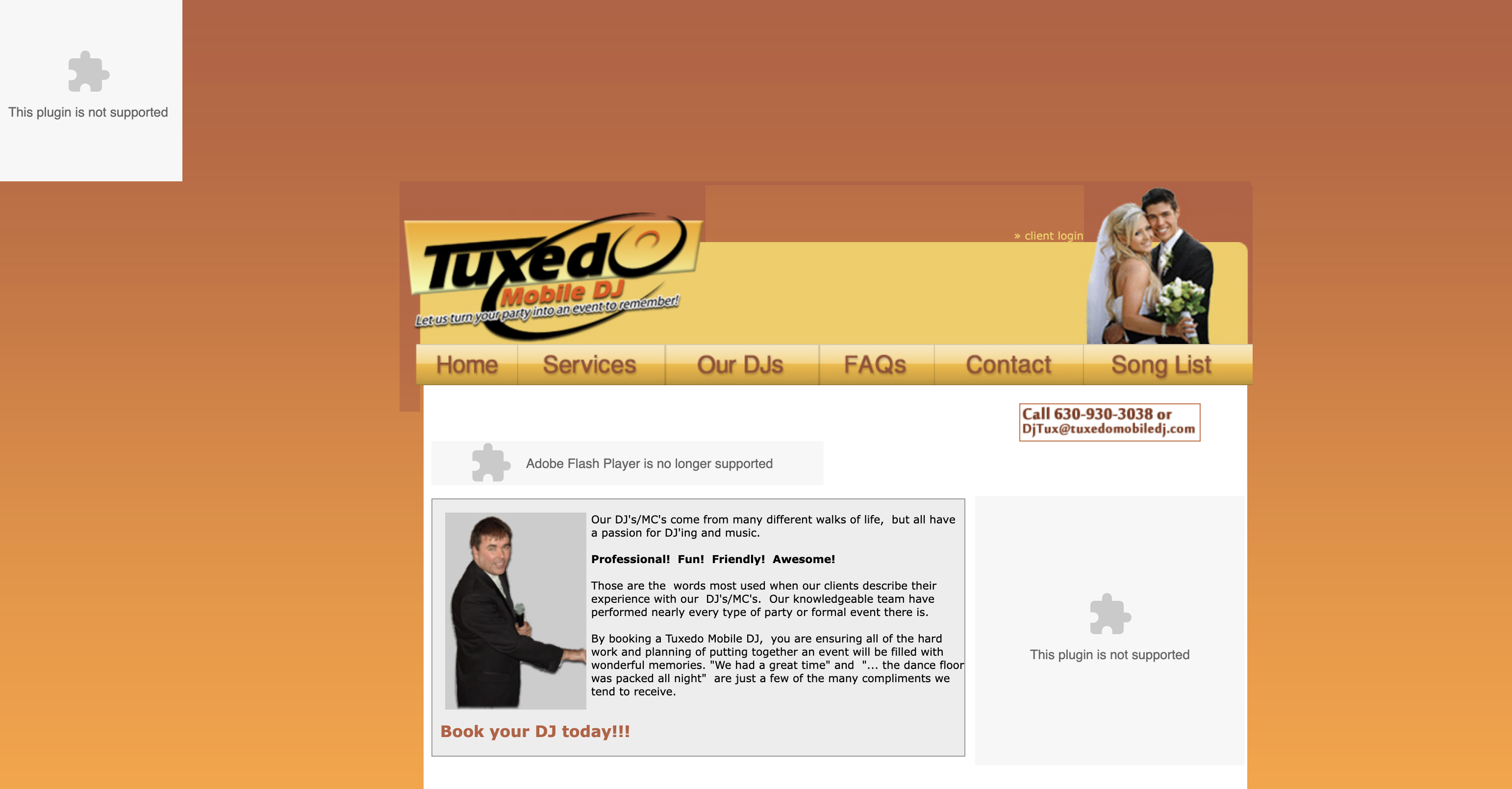
After:

As you can see, the styling and content stayed largely the same, but I cleaned up most of the outdated or ‘broken’ aspects.
The workflow
Since my Dad isn’t a developer, I needed a workflow that didn’t require him to run any tools. What I landed on was to make changes locally, review them, commit to git, then push the changed files back to BlueHost over SFTP. It’s not a CI/CD pipeline, but it’s good enough for a small static site, and every change is now tracked in git. If something breaks, I can diff against the last working commit and know exactly what changed.
The site is still the one my Dad built. I just cleared out the parts that were broken. It loads clean now, looks sharp on a modern screen, and has a commit history for the first time.